I want to address, in a preliminary way, a key area or issue for serious fine art photography and even society and culture as a whole. The kind of media culture increasingly present in our society has made it much harder for the artist to do serious art. It has led to an emphasis on two key areas in the wrong way: the celebration of the spectacle and the creative counter retreat to an emphasis on the mundane.
What am I talking about here? This issue is much too complicated to be reduced to a simple post, but too important not to discuss so at least let’s begin with a preliminary effort. Let’s start with the easier subject. Much of mass culture is dedicated to a constant amping up of spectacle. Spectacle draws social media attention and fuels likes or at least, viewers. As the competition for attention gets greater and greater and the number of participants in mass culture increases with the ever expanding availability of access, people go to further and further lengths to make spectacle and get what they think are the rewards of attention or fame it can provide.
There are a hundred examples of this in every sphere of society and culture. It’s so obvious I’m not even going to go into all the examples of this because it’s ubiquitous. If you don’t know that you are surrounded by purposefully and increasingly amped up spectacle culturally and that this gets more extreme year by year, then look around you, and stop being a fish in water.
Spectacle becomes a key to social control and manipulation. It makes the everyday feel boring and draws people into the unreal, virtual world away from the real to a realm where they can be more easily changed in the ways desired by power. This is nothing new. Leaders have long used spectacle to overawe and control people. Or to use a more neutral word persuade them. While I am not necessarily in agreement with his overall politics, the French thinker, Guy Debord, discusses this use extensively in his work, The Society of the Spectacle. For those who know popular culture, both Malcolm McLaren, who managed the Sex Pistols, and Bernie Rhodes, who managed the Clash, used this idea of turning spectacle back against itself in the Punk Movement. Who knows, maybe even the current President in the White House, whatever you think of him, uses some of these same principles all the time against the existing media.
But while the use of spectacle in politics and economics and popular culture, may be to some extent inevitable in today’s world and follows a logic of its own given the new media, falling prey to the principle of spectacle in fine art photography is a disaster and should be resisted. I won’t mention specific famous photographers, who have ruined their full creative potential by taking the spectacle path, but it’s a serious problem.
Why? Because the spectacle is the enemy of artistic truth and depth. It is to give in to popular culture and ultimately group power and depersonalization way too much. A politician or businessman may have no choice. Even Debord, one of the spectacles biggest critics after all, argues that a politics opposed to spectacle hinges on turning spectacle back against itself in what he refers to as detournement. Maybe serious artists can do this also, but I have my doubts. A few like a Salvador Dali or the Dadaists may have succeeded at this in a much earlier period where they had less competition so to speak. I don’t really think serious fine art photography, which depends so much on the real, can play this game and succeed at it in any deeper artistic way, especially given how extreme and pervasive the spectacle has become overall.
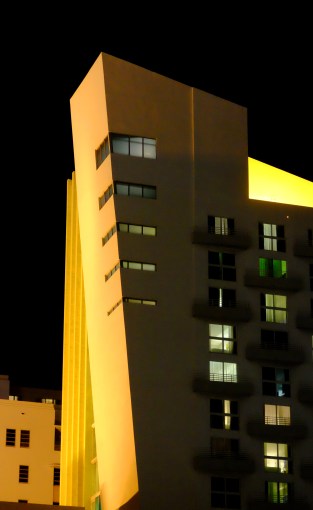
What the photographer can do is photograph places where spectacle has some presence, but not as spectacle per se, in a manner where the image retains a real aspect. One of my favorite locations to do the Creative Abstract Design style photos, which are the subject of this site, is in South Beach. And yes, there is all that neon and color, which has some spectacle aspect to it. But I would contend those photos are not really spectacle images despite that. They are and the place itself is ultimately too real for that when actually experienced. The images lack the usual overall spectacle narrative elements. In fact, they are a kind of cure for the virtual, unreal spectacle. Could I make these photos look like a glossy and unreal movie set? Sure. But South Beach actually experienced is more real than that. Even with all that bold color the details show the reality.


The goal of the image, in this case, is not only to create a more real spectacle image as such, but to turn the setting into an image where complex form and color is able to transcend the spectacle per se. It’s not detournement, it’s transcendence. This is accomplished by attempting to transform the image into much more of an idealized pure abstraction, to open up a kind of freed up “Mondrian” space of pure composition from these interesting objects in the world.
The second mistake made that ruins fine art photography is to overly take the mundane route. In such a world of overdetermined spectacle, there is often an understandable but simplistic tendency for the artist to go in the opposite direction and emphasize instead the mundane. How many curators and artists today in the field celebrate way too much the most kitschy, mundane images as somehow great art? I would argue far too many.
Now, the following account may be in part incorrect, and it’s hard to really know for sure. I read it many years ago and no longer have the reference or the work that made this argument, but supposedly, it has been said by some people, that when one of the Rockefeller heirs took over a lot of the funding for MOMA, he didn’t want to spend what his mother had spent. He wanted a museum that would pay for itself more. The new curator of photography, the now famous John Szarkowski, was hired with a handshake, and his answer was among other things to celebrate William Eggleston, who in turn celebrated the kitschy and mundane. These images and other strategies would bring in the “everyday people” to the shows I guess and increase revenue, if this argument is correct. As for the artists, if in an earlier era everyone had to visit NYC to view Stieglitz’s translucent prints and figure out the look, now the mundane and the New Color photographers were “in” and everyone needed to do the mundane style as a fine art photographer.
Supposedly, this is when color photography started to be taken seriously. Never mind Ernst Haas’s highly poetic images shown a decade earlier. Haas still idealized what he photographed, but its pretty hard to argue either Eggleston or Stephen Shore idealized very much if anything. The problem is a whole bunch of later curators were Szarkowski’s prodigies, and this no doubt had something to do with ingraining this love of the mundane in the field.
I am painting with broad brush strokes and some or even all of this account may be just plain wrong, and I would certainly like to know more about how this actually played out by someone who really knows. It’s an important artistic question. But the mundane, like the spectacle, has certainly become enshrined for whatever reasons in the field. There’s no question about that.
Now, one response of photographers to the spectacle is to go the other way. I understand the intention. Fight the spectacle by embracing the mundane. The politicization of the field by the socialists has only accelerated this emphasis. The mundane becomes a resistant point to existing authority. Fight the opiating idealization of power with the real mundane world. I’ll remain neutral about the politics, but I get it.
However, this is also a trap for the serious fine art photographer. If the photographer does the everyday, they should not do it in what is actually in many ways a very taken for granted “middle class” way. They should transcend it and turn it into a highly idealized image, regardless of what the radical ethos says against such an effort. They should present it as something complex and wondrous. They should use much more epical concepts and ideas. They should free up the potential of the field and raise up the mundane in the manner broadly suggested for art as a whole by Kandinsky years ago, not reduce it to the mundane as such. Consider a mundane image of “grafitti” broadly to include any altered surface with markings of some sort.


In each case, I have shown a mundane object or objects but in an idealized way. I would argue this is a more artistic and powerful approach. I know Eggleston and Shore and all the latter mundane photographers sometimes do this kind of idealization—-but not much, and certainly hardly ever on purpose. Where is Eggleston’s photo of a beautiful figure pushing a shopping cart out of a grocery store? Where are the idealizing as opposed to disdainful photos.
I’m not saying by the way that the Rockefellers were not great benefactors of the arts. I actually have tremendous respect for much that they’ve done including their Museum support over the years and am very grateful indeed for all the National Parks they’ve helped make. And I’m not even saying Szarkowski and his followers were not important and talented curators or that Eggleston and Shore are not major artists who deserve much of the attention the’ve gotten. What I am saying is that past a certain point this trajectory to celebrate the mundane is holding back fine art photography and has gone too far. Both the photographic celebration of the spectacle and the preoccupation with the mundane have run their course. Neither can take the field to where it now needs to go.
The field of fine art photography needs to lead the way back to the promise of Modernism and the effort at reconciling the real with the ideal in the image. That effort and the many concepts that must be addressed to get there are, unfortunately these days, any way being ignored by these two shortcuts to artistic production. We don’t need a fake ideal spectacle giving in to the unreal virtual or a lowered down too conventional mundane- real. No, we need the fine art photographer to go back to the real and try, even if unsuccessfully, to make a more idealizing image out of it. Honestly, at this point anything else in fine art photography is really not very interesting, especially for the artists themselves. How many more spectacle photos does the world need or how many more mundane images?
If you are interested in these kinds of issues be sure to read the newly released work on Kindle, Creative Abstract Design: Towards a New Modernist Photography for the 21st Century, available on Amazon.