There is unfortunately a mistaken belief in much of fine art photography that the higher level issues in painting are largely irrelevant for photography. More’s the pity because this has led photography astray from its true calling as a highly conceptual art form that can in its own way address some of the more important questions of the fine art world. One of the goals of the style argued for on this site is to change this perspective and suggest some of the interesting questions such a redefinition raises.
Actually in regards to higher level conceptual issues, fine art photography has distinct advantages over painting. The fact that a photographer can do literally hundreds of images in the time it takes a painter to do one mere preliminary painting or even sketch can at least in certain ways be a key advantage. However, this broader expanse of potential work means the ability of the photographer to select what images matter and which don’t (a skill ignored in Susan Sontag’s annoying account of the field) is obviously essential. Selectivity is everything in photography, but that depends ultimately on conceptual sophistication regarding significant aesthetic questions.
Assuming, though, that initial qualification, difficult conceptual issues can in some ways be more fully explored and taken further in photography than in practically any other art medium. The painter in fact given the difficulties in the initial and actual creative process cannot possibly work through many conceptual issues as extensively—-it would take a 100 lifetimes to produce that much quality work. On the other hand the photographer can deeply explore certain key concepts as they work through their imagery more extensively. Note, I am not saying that the process and difficulty of painting does not require important acknowledgment artistically or that there are not key things conceptually a photographer cannot do, but simply that theoretically the question is far more complex than the usual starting premises that conventionally govern the broader dialogue regarding the two disciplines.
Part of the problem for fine art photography in the too limited conventional discourse originates in Stieglitz’s overly large influence on the earlier development of the field. This is not a work in art history per se, but let’s just say that his desire to separate photography from 19th century pictorialism by celebrating straight photography while well intended went too far. Despite showing many of the the most important Abstract painters at his own gallery for, in some cases, the first time in the US, when it came to photography he wrongly suggested that it was a completely different conceptual space from painting. He really let into the pantheon of photography only one main higher level idea from Abstract Art and that was Kandinsky’s principle of equivalence. The idea that the artists inner life would find a reflection or resonance in the images they made. In my book Creative Abstract Design: Towards a New Modernist Photography for the 21st century available as a Kindle reprint on Amazon, I go into much more detail on this question, but let’s just say here that as he worked out in the idea of equivalence the relationship between subject and object this was understood in way too limited and not a relational enough way. More importantly, adding the idea without all the other key concepts and scaffolding of Abstract Art it could not really take fine art photography as far as the field’s development required. The result predictably enough, when this approach proved in the longer run insufficient, was a turn to more documentary and mundane-kitsch and popular culture work pretending to be fine art and attempting to fill the resulting vacuum.
All of which brings us to the subject of this post and two key conceptual questions that were fought over by the great painters Theo Van Doesburg and Piet Mondrian. Both were key founders of Abstract Art and the Dutch De Stijl Movement which sought to create a transcendent art approach based on geometry, primary color, and abstraction. However, they parted company over at least two key issues. They both sought to turn painting and art as such away from the real to an abstract spiritual realm. They went too far in this effort at least for any direct application of their full ideas to fine art photography which always still needs the real original object in its compositions, but we are considering here two crucial aspects of this general effort at abstraction which are very relevant indeed for the serious photographer.
For Mondrian’s style, which he called Neo-Plasticism, the goal was a contemplative complete state of harmony in which like the Christian cross that he thought revealed a transcendental realm, consisted exclusively of strict verticals and horizontal lines –the later representing the open real horizon or reality’s vast and mutable world if you will and the former the vertical spiritual ascent. There was no place in this perfect symbolic representation of the universal world for the dreaded and disruptive shattering tension of the diagonal which disturbed this more fundamental relationship between the real and ideal. Van Doesburg, on the other hand, thought diagonals had there place and were crucial to add a much more compositionally direct energy and dynamism to the abstract composition. Mondrian, because of that disruptive heresy by his colleague, left the De Stijl art movement he had helped found, and the two men’s friendship at least for a while ended.
Now, this first question of diagonals “yes or no?” is not at first glance terribly important for the fine art photographer and this is true even at the most basic level for the Creative Abstract Design photography style, which is heavily influenced by these art precursors. Obviously, reality itself in photography contains plenty of diagonals and for a photographer to limit their work to only images which are purely made up of only vertical and horizontal structure and lines might be way too limiting even for a style that emphasizes abstraction. In this regard, can the photographer really say like Mondrian a complete “no” to diagonals? I suppose they could in theory, but hardly realistically in practice. Mondrian’s more extreme position might only be applicable fully to the work of a painter. More important though is the deeper question of whether in design terms the artist—whatever their medium—seeks the contemplative completeness of Mondrian or the greater direct tension and contradiction of Van Doesburg’s more dynamic compositional principles in their art. It is also whether the photographer even really understands the deeper design principles of diagonals, verticals, and horizontals as they play out in their work.
Personally, I would simply suggest that deciding how much to introduce the dreaded diagonal Mondrian so rejected should always be considered by the fine art photographer in choosing their specific brackets and ultimately the portfolio of their work and the form of their compositions. This general issue needs to be understood and applied in very specific images. Hence, the Creative Abstract Design style I’m defending here says “aye” to the diagonal. Even Mondrian in his later work seemed to recognize that his original scheme was too rigid and that the horizontal by itself missed something essential about the real horizon it symbolized. He tried to re-add this missing energy of the diagonal not by its inclusion but through introducing additional frenetic complexity to his compositions in his later NYC works.
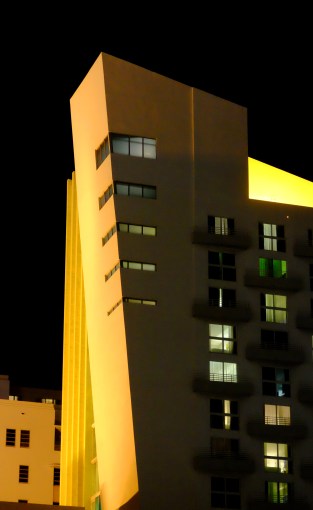
Here are a few Creative Abstract Design photos to consider where the relationship of diagonals, horizontals and verticals are essential:


The second question that divided Mondrian and Van Doesburg is whether individualism or collectivism should be emphasized in the approach to abstract art. This question might be even more important given the current general status of the medium for the fine art photographer. Van Doesburg felt that Mondrian made the individual artist ultimately too important in his approach. He believed that the higher spiritual level in art went beyond the individual’s subjectivity or privileging of the self too much. Higher level art required that the art not become about the individual’s unique understanding, but move instead to the level of the collective if it was to transcend the variable into the eternal.
Here, Creative Abstract Design says an unequivocal “no.” It celebrates the individual and while it agrees that the subjective must link itself in some way to something deeper and not be simply arbitrary, the idea that the collective group is a good repository or vehicle for the transcendent at least in art it fully rejects. While certain aspects of what might, perhaps, though even this is debatable, be called collective culture are not insignificant for the fine art photographer these do not rise to the level of fine art, per se. Without a doubt a great many of the best images in the style are it is true built on the creative works of architects, designers, even with the figurative, fashion culture in part, and even in nature those institutions that have made nature accessible in the first place. However, it is the responsibility of the individual artist to from all those foundational visual elements take them to a new and highly personal expressive level in their art.
Nor does the Creative Abstract Design style ever believe that the most important creative work, even at a cultural level, is done really by groups. It is, actually, always pioneered by a few individual artists or creative figures. While the group can develop those ideas in some cases further ultimately, simply a group per se is way too mundane and involves way too much of a taken for granted identity to do anything but limit that development. When the “group” does work in taking fine art further it does so by trying to foster a creative space where there are lots of important individual artists who come together on certain key principles, but still are not reducible to a depersonalized collective.
In fact, one of the things these days that is limiting fine art photography is too many documentary fine artists, some of whom have become the valets to politics, not pursuing their own individuation to any real extent and overemphasizing only the collective aspect in their art.
Hence, in summary the Creative Abstract Design style this site is championing says a big “yes” to diagonals, but a definite “no” to collectivism!
If interested in the approach be sure to check out the new Kindle book, Creative Abstract Design: Towards A New Modernist Photography for the 21st Century available on Amazon.com.